

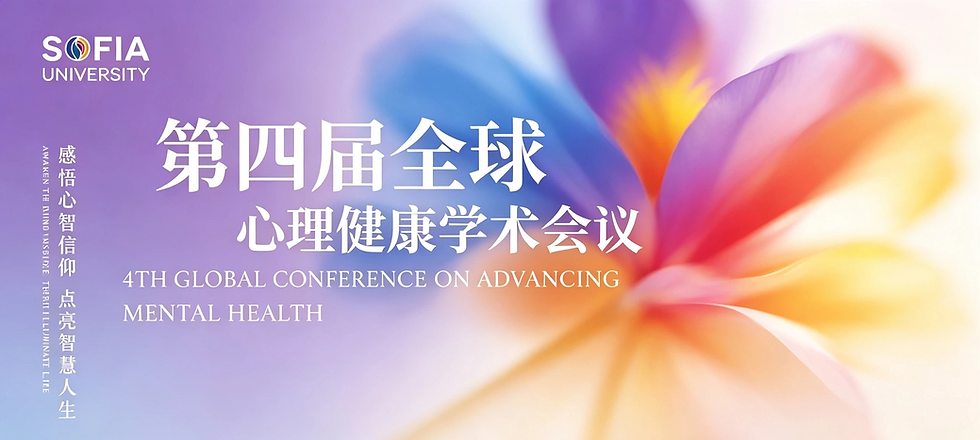
On July 18–19, 2026, the 4th Global Conference on Advancing Mental Health – China Session was held in Shanghai. Dozens of experts and scholars from China and around the world—representing psychology, education, AI and technology, healing practices, and whole-person development—joined more than 400 industry professionals, university and college faculty, master’s and doctoral students, and psychology enthusiasts. Through academic exchange, experiential learning, and cross-cultural dialogue, the conference opened a new chapter of interdisciplinary collaboration in mental health and whole-person development.


The 4th Global Conference on Advancing Mental Health featured both a U.S. main session and a China session. In China, the conference was jointly hosted by Sofia University and Shanghai Lida University, with the United Nations Population Fund (UNFPA) serving as a strategic partner and China Education Television providing media support.
Under the theme “Awakening Within, Creating Together in Harmony,” the conference was grounded in transpersonal psychology and centered on four core areas:
-
Roots · Scholarship: Transpersonal psychology and interdisciplinary dialogue
-
Bridge · Technology: Using AI to make mental health support more accessible
-
Heart · Practice: Healing, personal transformation, and integrative growth
-
Beyond Boundaries · Co-creation: Building connections and an open, collaborative ecosystem
By bringing together Eastern and Western wisdom, emerging technologies, and practical approaches to human development, the conference explored pathways for transpersonal growth and advanced a more holistic, inclusive, accessible, and interconnected global mental health ecosystem.
The conference received extensive coverage from more than 200 leading media outlets, digital platforms, and social media channels, including China Education Television, Shanghai Education Television, Guangming Online, Xinhua News, People’s Daily Online, Global Times Online, China.com.cn, China Daily, China National Radio, CCTV.com, China Youth Network, China Education Daily, China Radio International, Youth Daily, Xinmin Evening News, Dafeng News, Eastday, Sohu, Sina, Tencent, and The Paper.

Mental health has become a shared global challenge. At the same time, the rapid development of artificial intelligence and digital technologies, together with changes in the social environment, is profoundly reshaping how people learn, work, and live.
During the opening ceremony, Sofia University, as a long-standing advocate of whole-person development, joined the United Nations Population Fund and other partners in launching the “Embodied Future · Human Flourishing” Global Mental Health and Whole-Person Development Initiative. The initiative seeks to connect psychology, education, technology, and other fields, while promoting a development model centered on human health, growth, and well-being and offering new perspectives for the future of society.

Another initiative “Intelligence as a Companion · Co-Creating the Future” was also launched. Artificial intelligence is profoundly reshaping both education and mental health services, creating new opportunities and challenges for talent development and whole-person growth in this new era.
The initiative focuses on three key areas: educational innovation, mental health services, and support for whole-person development. It calls for the responsible and human-centered application of technology, promotes the integration of intelligent technologies with compassionate human care, and seeks to ensure that technology genuinely serves people and supports their sustained growth and long-term development.
The conference brought together senior representatives from a wide range of fields. Drawing on perspectives from public diplomacy, United Nations youth development, population well-being, and higher education, participants explored the future direction of mental health in the digital age and helped shape a shared, human-centered vision for the field.

Another initiative “Intelligence as a Companion · Co-Creating the Future” was also launched. Artificial intelligence is profoundly reshaping both education and mental health services, creating new opportunities and challenges for talent development and whole-person growth in this new era.
The initiative focuses on three key areas: educational innovation, mental health services, and support for whole-person development. It calls for the responsible and human-centered application of technology, promotes the integration of intelligent technologies with compassionate human care, and seeks to ensure that technology genuinely serves people and supports their sustained growth and long-term development.
The conference brought together senior representatives from a wide range of fields. Drawing on perspectives from public diplomacy, United Nations youth development, population well-being, and higher education, participants explored the future direction of mental health in the digital age and helped shape a shared, human-centered vision for the field.

Zhou Hanmin, Member of the Standing Committee of the Chinese People’s Political Consultative Conference and President of the Shanghai Public Diplomacy Association, attended the conference as an invited guest. Speaking about the relationship between AI and mental health, he emphasized that the conference is fundamentally motivated by a commitment to serving young people.
For youth mental health, he noted that the greatest value of AI is not to replace human emotion, but to strengthen psychological resilience; not to replace human connection, but to help people build more positive, compassionate, and meaningful relationships with one another and with society.